Project Coordinator: Assoc. Prof. Mustafa Mert Ankaralı
Project Researchers: Eminalp Koyuncu, Cankan Çelik
Project Type: TUBITAK 1001
Project Budget: Not Finalized
Project Duration: 30 Months
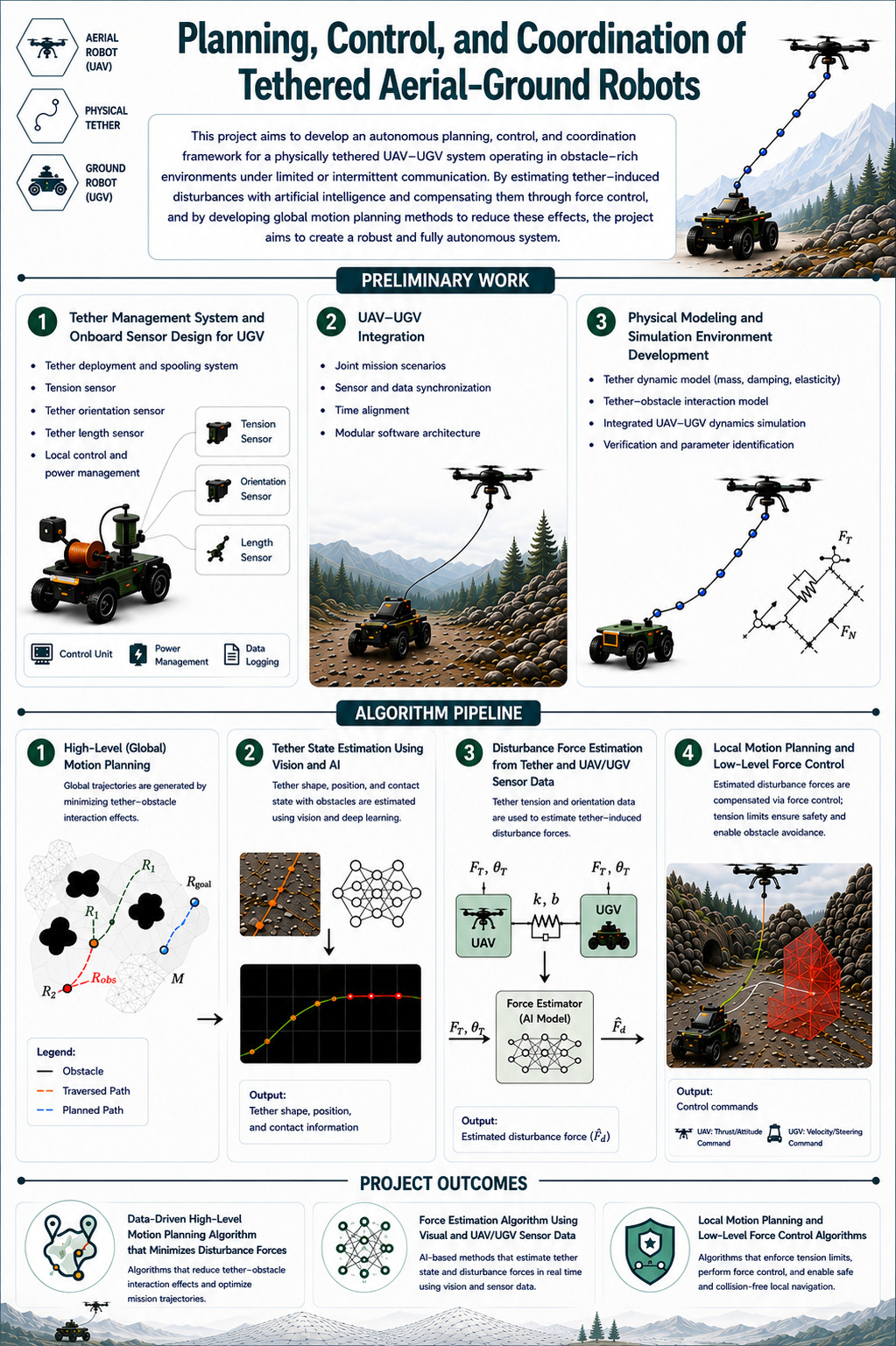
This project aims to develop an autonomous planning, control, and coordination framework for a physically tethered unmanned aerial vehicle (UAV) and unmanned ground vehicle (UGV) operating in obstacle-rich environments under limited or intermittent communication. Existing tethered aerial-ground systems generally focus on power supply, tether-length management, relative localization, or basic trajectory tracking, while the effects of tether tension and tether-obstacle interaction are rarely integrated systematically into obstacle avoidance, closed-loop control, and high-level decision-making. This limitation reduces operational reliability and maintains dependence on human operators in complex field missions.
Within the scope of the project, tether dynamics will be modeled and experimentally validated, and an actuated tether-management system capable of measuring tether tension, length, and orientation will be integrated into the ground robot. Vision-based algorithms will be developed to estimate tether geometry and detect tether-obstacle contact, while force-state estimators will infer tether-induced disturbances using camera, thrust, tension, and tether-end orientation data. The estimated disturbances will be compensated through admittance-based low-level force control and tension-constrained local motion planning. In parallel, high-level trajectory optimization methods will generate mission routes that minimize the disruptive effects of tether-obstacle interactions. These algorithms will operate locally on both robots, enabling coordinated and stable operation even when direct communication is unavailable.
The resulting system is expected to provide a robust and fully autonomous tethered UAV-UGV platform. The proposed framework will contribute to the literature by combining visual tether perception, force estimation, disturbance compensation, obstacle avoidance, and high-level planning within a unified architecture. The project outcomes are anticipated to offer significant value for applications such as firefighting, disaster response, energy infrastructure maintenance, industrial inspection, logistics, and defense operations.