
This page is created to inform any interested participants regarding the seminars to be conducted for the EE690 Graduate Seminars course. The schedule and the content will be updated throughout the semester.
2022-2023 Fall Graduate Seminars
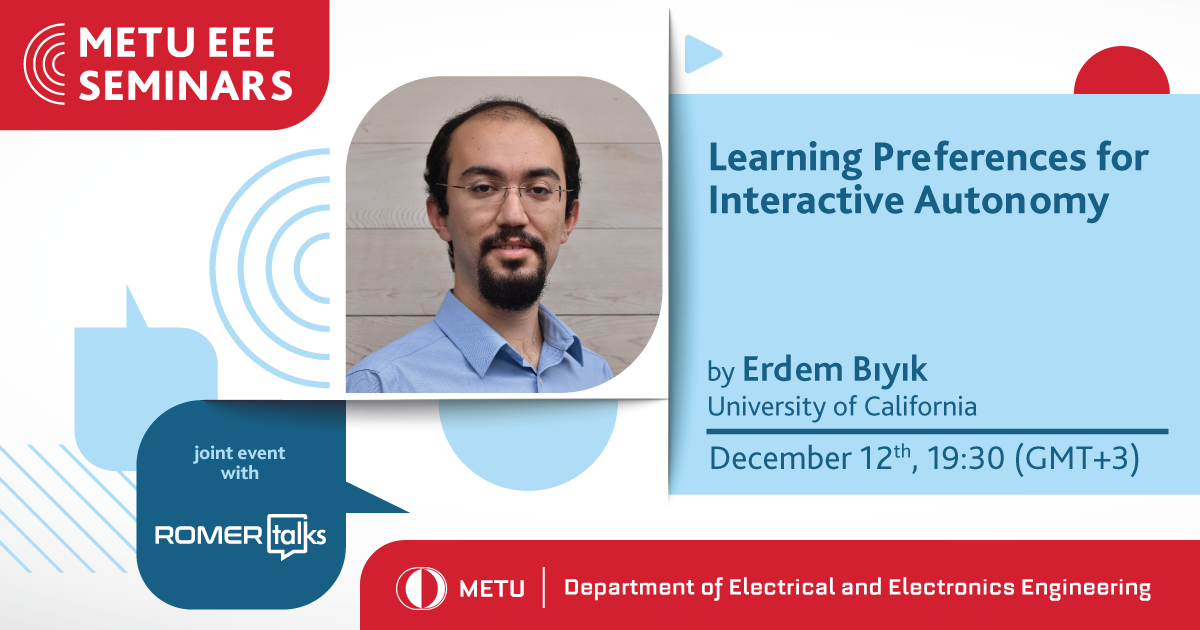
Title: Learning Preferences for Interactive Autonomy
Time: December 12th, 19:30 (GMT+3)
Abstract:
In human-robot interaction or more generally multi-agent systems, we often have decentralized agents that need to perform a task together. In such settings, it is crucial to have the ability to anticipate the actions of other agents. Without this ability, the agents are often doomed to perform very poorly. Humans are usually good at this, and it is mostly because we can have good estimates of what other agents are trying to do. We want to give such an ability to robots through reward learning and partner modeling. In this talk, I am going to talk about active learning approaches to this problem and how we can leverage preference data to learn objectives. I am going to show how preferences can help reward learning in the settings where demonstration data may fail, and how partner-modeling enables decentralized agents to cooperate efficiently.
Bio:
Erdem Bıyık is a postdoctoral researcher at the Center for Human-Compatible Artificial Intelligence at the University of California, Berkeley. He received his B.Sc. degree from Bilkent University, Turkey, in 2017; and Ph.D. degree from Stanford University in 2022. His research interests lie in the intersection of robotics, artificial intelligence, machine learning and game theory. He is interested in enabling robots to actively learn from various forms of human feedback and designing robot policies to improve the efficiency of multi-agent systems both in cooperative and competitive settings. He also worked at Google as a research intern in 2021 where he adapted his active robot learning algorithms to recommender systems. He will join the University of Southern California as an assistant professor in 2023.
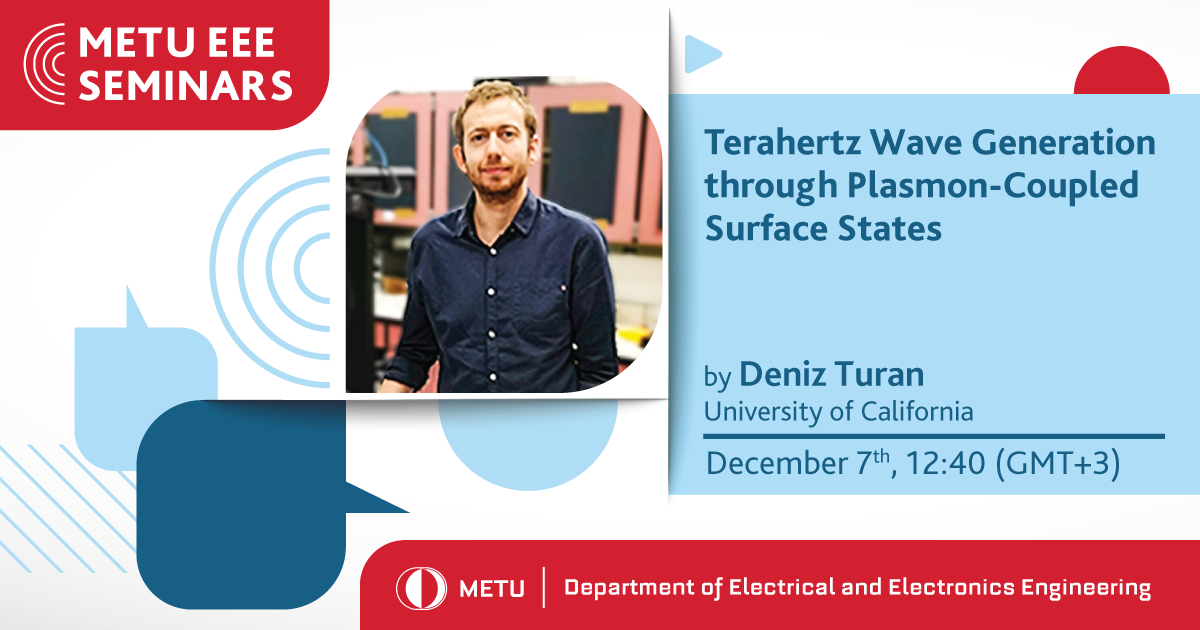
Title: Terahertz Wave Generation through Plasmon-Coupled Surface States
Time: December 7th, 12:40 (GMT+3)
Abstract: Surface states generally degrade semiconductor device performance by raising the charge injection barrier height, introducing localized trap states, inducing surface leakage current, and altering the electric potential. During my doctoral studies, I investigated the unique electrochemical characteristics of semiconductor surface states and showed that the built-in electric field created by the surface states can be harnessed to enable passive terahertz generation. Photo-excited surface plasmons are coupled to the surface states to generate an electron gas, which is routed to a nanoantenna array through the electric field created by the surface states. The induced current on the nanoantennas, which contains mixing product of different optical frequency components, generates radiation at the beat frequencies of the incident photons. Through plasmon-coupled surface states, we demonstrate passive terahertz generation with record-high efficiencies that exceed nonlinear optical methods by 4-orders of magnitude.
Bio: Deniz Turan got his B.S. in Electrical and Electronics Engineering from Middle East Technical University with a minor in Solid State Physics in 2014. He then obtained his M.S. and Ph.D. degrees in Electrical Engineering from the University of California, Los Angeles in 2016 and 2021, respectively. During his time at UCLA, he developed a new bias-free photoconductive device that can generate terahertz radiation through plasmon-coupled surface states. He is the recipient of the UCLA Dissertation Year Fellowship, IEEE Antenna and Propagation Society Doctoral Grant, UCLA Henry Samueli Fellowship, and UCLA Dean’s Scholar Award. His research has appeared in 12 peer-reviewed journal papers and over 20 conference proceedings. He currently works as Packaging R&D Engineer at Intel Corporation.
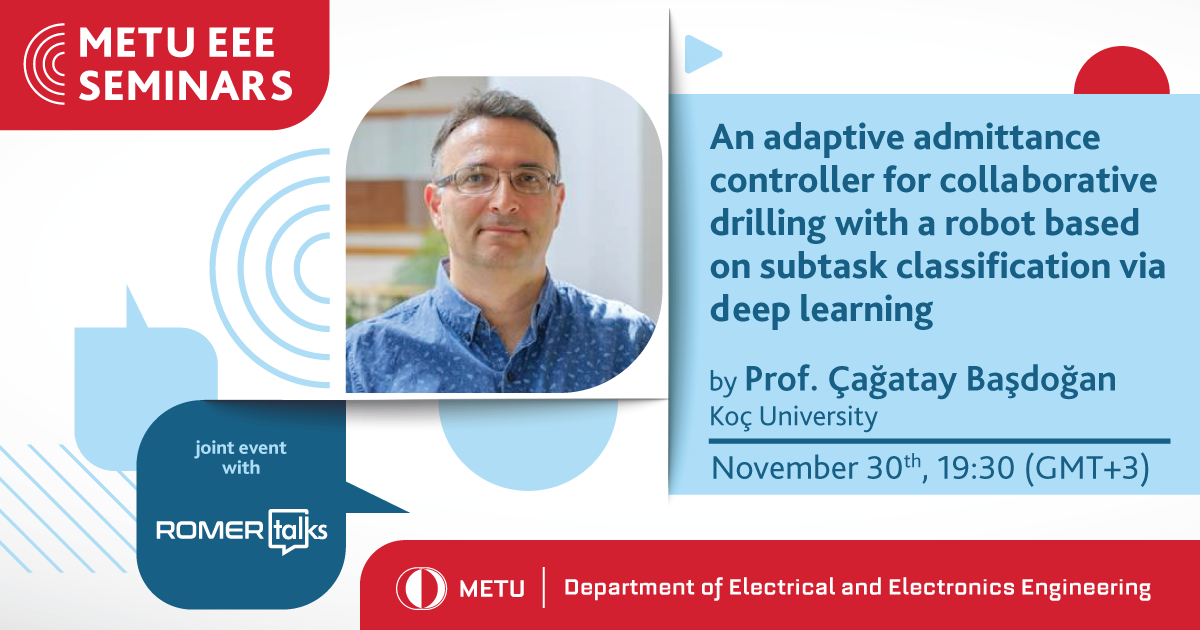
Title: An adaptive admittance controller for collaborative drilling with a robot based on subtask classification via deep learning
Time: November 30th, 19:30 (GMT+3)
Abstract: We propose a supervised learning approach based on an Artificial Neural Network (ANN) model for real-time classification of subtasks in a physical human–robot interaction (pHRI) task involving contact with a stiff environment. In this regard, we consider three subtasks for a given pHRI task: Idle, Driving, and Contact. Based on this classification, the parameters of an admittance controller that regulates the interaction between human and robot are adjusted adaptively in real time to make the robot more transparent to the operator (i.e. less resistant) during the Driving phase and more stable during the Contact phase. The Idle phase is primarily used to detect the initiation of task. Experimental results have shown that the ANN model can learn to detect the subtasks under different admittance controller conditions with an accuracy of 98% for 12 participants. Finally, we show that the admittance adaptation based on the proposed subtask classifier leads to 20% lower human effort (i.e. higher transparency) in the Driving phase and 25% lower oscillation amplitude (i.e. higher stability) during drilling in the Contact phase compared to an admittance controller with fixed parameters.
Bio: Prof. Basdogan is a member of faculty in College of Engineering at Koc University since 2002. Before joining to Koc University, he was a senior member of technical staff at Information and Computer Science Division of NASA-Jet Propulsion Laboratory of California Institute of Technology (Caltech) from 1999 to 2002. At JPL, he worked on 3D reconstruction of Martian models from stereo images captured by a rover and their haptic visualization on Earth. He moved to JPL from Massachusetts Institute of Technology (MIT) where he was a research scientist and principal investigator at MIT Research Laboratory of Electronics and a member of the MIT Touch Lab from 1996 to 1999. At MIT, he was involved in the development of algorithms that enable a user to touch and feel virtual objects through a haptic device (a force-reflecting robotic arm). He received his Ph.D. degree from Southern Methodist University in 1994 and worked on medical simulation and robotics for Musculographics Inc. at Northwestern University Research Park for two years before moving to MIT. Prof. Basdogan conducts research and development in the areas of human-machine interfaces, control systems, robotics, mechatronics, human-robot interaction, biomechanics, computer graphics, and virtual reality technology. In particular, he is known for his work in the area of human and machine haptics (sense of touch) with applications to medical robotics and simulation, robotic path planning, micro/nano/optical tele-manipulation, human-robot interaction, molecular docking, information visualization, and human perception and cognition. In addition to serving in the program and organizational committees of several conferences and journals, he also chaired the IEEE World Haptics Conference in 2011.
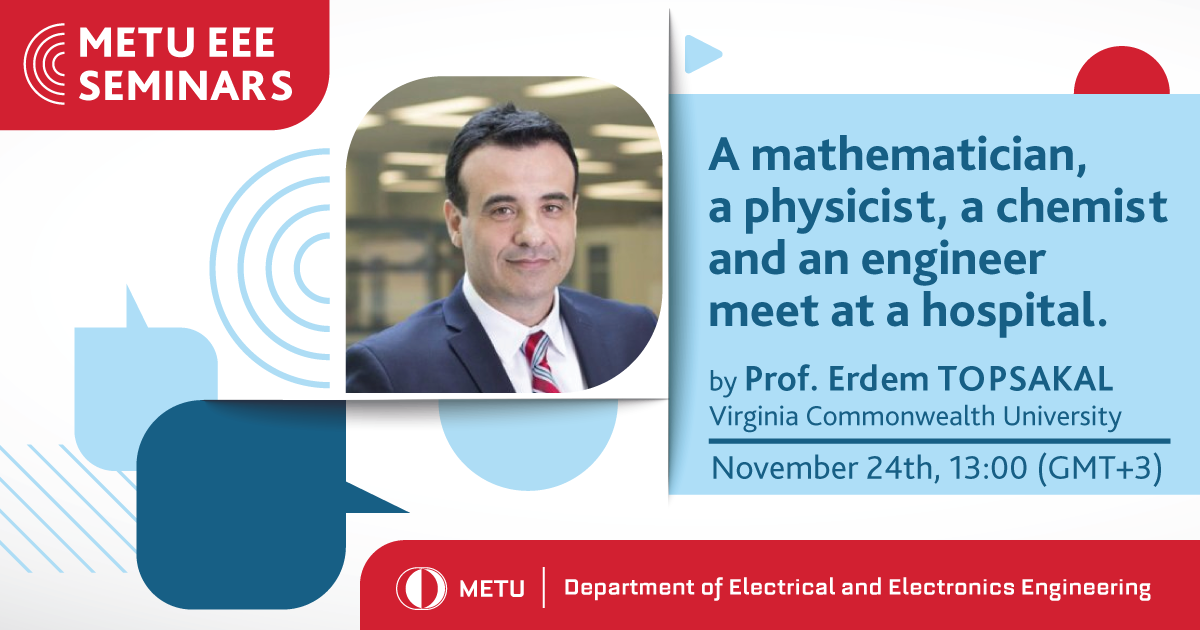
Title: A mathematician, a physicist, a chemist and an engineer meet at a hospital
Time: November 24th, 13:00 (GMT+3)
Abstract:This talk starts with an introduction to one of the most impactful inventions of the 21st century, Magnetic Resonance Imaging-MRI, and how the work of 4 scientists resulted in a device that has changed medical diagnostics forever. We will dive deep into the mathematics, physics and Electromagnetics behind conventional MRI machines and discuss in detail how medical images come to life. We will conclude the talk with some remarks about the future of MRI and how the recent development in AI and Machine Learning will shape medical imaging for years to come.
Bio: Dr. Erdem Topsakal received his BSc. degree in 1991, M.Sc. degree in 1993 and PhD degree in 1996 all in Electronics and Communication Engineering from Istanbul Technical University. He worked as an Assistant Professor in Electrical and Electronics Engineering Department at Istanbul Technical University between 1997 and 1998. He was a post-doctoral fellow from 1998 to 2001 and an assistant research scientist from 2001 to July 2003 in Electrical Engineering and Computer Science Department of the University of Michigan. In August 2003, he joined the Electrical and Computer Engineering Department of James Worth Bagley College of Engineering at Mississippi State University as an Assistant Professor and worked at the same institution until May 2015. He currently serves as the Senior Associate Dean at the College of Engineering at Virginia Commonwealth University responsible for finance, enrollment, marketing, and innovation.
Prior to that, he was the Electrical and Computer Engineering Department Chair at VCU between May 2015 and July 2022. His research areas include antenna design and analysis for medical and military applications, in particular the design of wearable and implantable antennas. He has published over 200 journal and conference papers, book chapters and a book in these areas. He is the recipient of URSI young scientist award in 1996, NATO fellowship in 1997, Mississippi State University Department of Electrical and Computer Engineering outstanding educator award in 2008, Bagley College of Engineering Research Paper of the Year Award in 2009, and 2010/2011 Mississippi State University State Pride Award in addition to about 16 awards with his undergraduate and graduate students. He served as the Associate Editor for IEEE Antennas and Wireless Propagation Letters (AWPL) from 2006-2015, Associate Editor for URSI Radio Science Bulletin 2011-2014, and Chair for URSI-USNC Commission K, Electromagnetics in Biology and Medicine from 2012-2015. He is currently the Chair of the USNC URSI student paper competition and serves on the steering committee for IEEE J-ERM (Journal of Electromagnetics, RF and Microwaves in Medicine and Biology. He is the Editor-in-Chief of IEEE Antennas and Propagation Society Digital Communications, and serves as the Director of Central Virginia Node of Commonwealth Cyber Initiative. He was inducted into the National Academy of Inventors VCU Chapter in 2022 based on his patents in implantable biosensors.
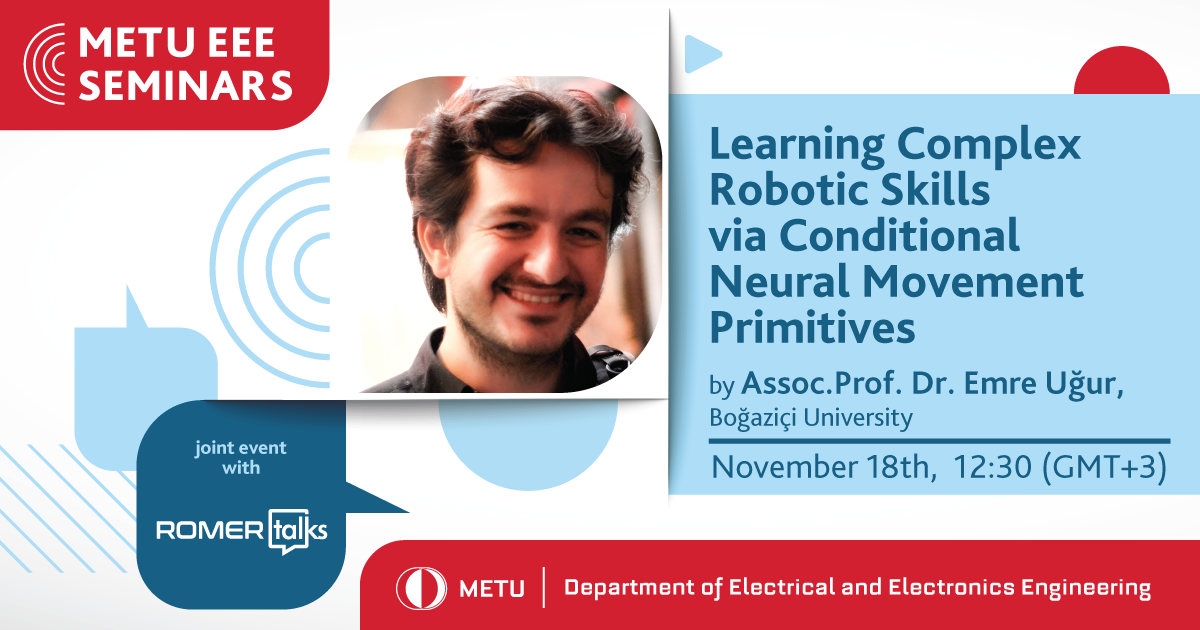
Title: Learning Complex Robotic Skills via Conditional Neural Movement Primitives
Time: November 18th, 12:30 (GMT+3)
Abstract: Predicting the consequences of one’s own actions is an important requirement for safe human-robot collaboration and its application to personal robotics. Neurophysiological and behavioral data suggest that the human brain benefits from internal forward models that continuously predict the outcomes of the generated motor commands for trajectory planning, movement control, and multi-step planning. In this talk, I will present our recent Learning from Demonstration framework that is based on Conditioned Neural Processes. CNMPs extract the prior knowledge directly from the training data by sampling observations from it, and use it to predict a conditional distribution over any other target points. CNMPs specifically learn complex temporal multi-modal sensorimotor relations in connection with external parameters and goals; produce movement trajectories in joint or task space; and execute these trajectories through a high-level feedback control loop. Conditioned with an external goal that is encoded in the sensorimotor space of the robot, predicted sensorimotor trajectory that is expected to be observed during the successful execution of the task is generated by the CNMP, and the corresponding motor commands are executed. After presenting the basic CNMP framework, I will talk about how to form flexible skills combining Learning from Demonstration and Reinforcement Learning via Representation Sharing, and the deep modality blending networks (DMBN), which creates a common latent space from multi-modal experience of a robot by blending multi-modal signals with a stochastic weighting mechanism.
Bio: Emre Ugur is an Associate Professor in Dept. of Computer Engineering, Bogazici University, the chair of the Cognitive Science MA Program, the vice-chair of the Dept. of Computer Engineering, and the head of the Cognition, Learning and Robotics (CoLoRs) lab (https://colors.cmpe.boun.edu.tr/). He received his BS, MSc, and Ph.D. degrees in Computer Engineering from Middle East Technical University (METU, Turkey). He was a research assistant in KOVAN Lab. METU (2003-2009); worked as a research scientist at ATR, Japan (2009-2013); visited Osaka University as a specially appointed Assist.&Assoc. Professor (2015&2016); and worked as a senior researcher at the University of Innsbruck (2013-2016). He was the Principle Investigator of the IMAGINE project supported by the European Commission. He is currently PI of the EXO-AI-FLEX and Deepsym projects supported by TUBITAK. He is interested in robotics, robot learning, and cognitive robotics.
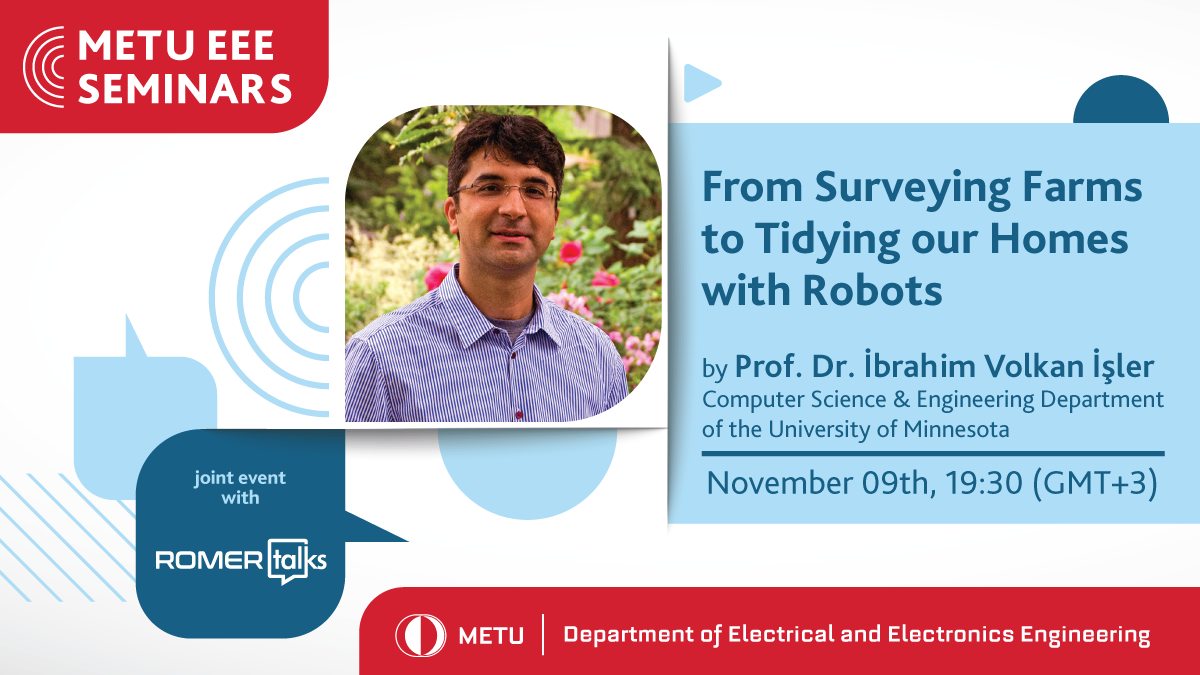
Title: From Surveying Farms to Tidying our Homes with Robots
Time: November 9th, 19:30 (GMT+3)
Abstract: For decades, the robotics community has been working on developing intelligent autonomous machines that can perform complex tasks in unstructured environments. We are now closer than ever to delivering on this promise. Robotic systems are being developed, tested and deployed for a wide range of applications. In this talk, I will present our work on building robots for agriculture and home automation which are two application domains with distinct sets of associated challenges. In agriculture, robots must be capable of operating on very large farms under rough conditions while maintaining precision to efficiently perform tasks such as yield mapping, fruit picking and weeding. In these applications, the state-of-the-art perception algorithms are capable of generating intermediate geometric representations of the environment. However, the resulting planning problems are often hard. I will present some of our work on tracking and mapping and give examples of field deployments. In home automation, the robots must be able to handle a large variety of objects and clutter. In such settings, generating precise geometric models as intermediate representations is not always possible. To address this challenge, I will present our recent and ongoing work on developing state representations for coupled perception and action planning for representative home automation applications such as decluttering.
Bio: Volkan Isler received the B.S. degree in computer engineering from Bogazici University, Istanbul, Turkey, in 1999, the M.S.E. and the Ph.D. degrees in computer and information science from the University of Pennsylvania, Philadelphia, PA, USA, in 2000 and 2004, respectively. He is a Professor with the University of Minnesota, Minneapolis, MN, USA, and the Head of Samsung AI Center, New York City, NY, USA. His research interests include robotics, sensing, and geometric algorithms.
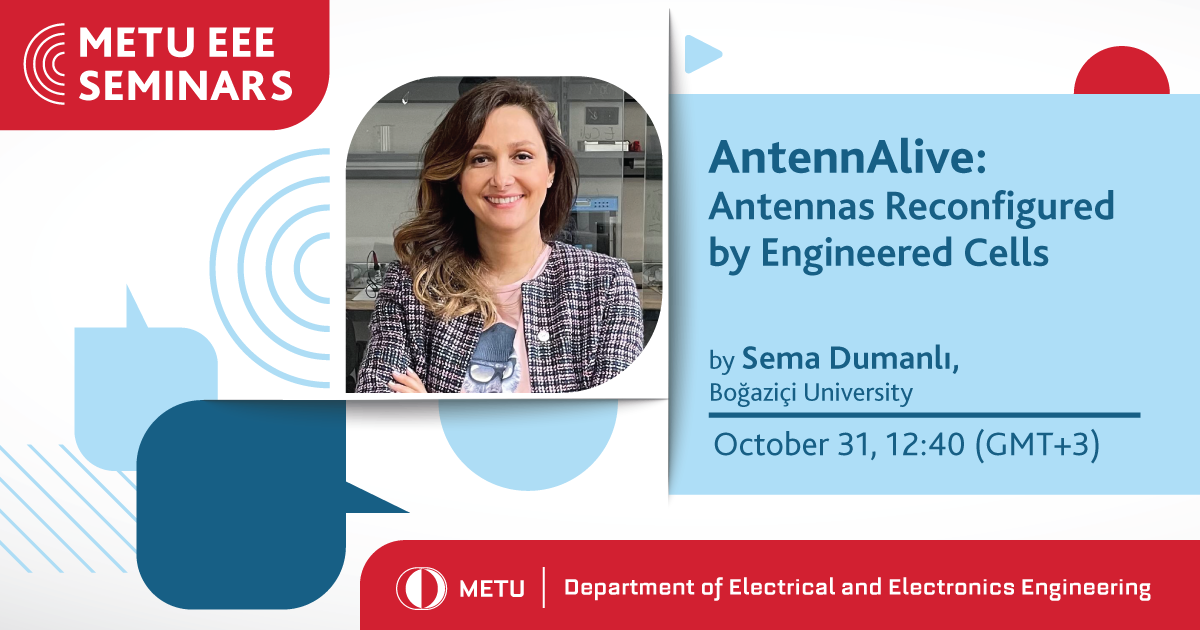
Title: AntennAlive: Antennas Reconfigured by Engineered Cells
Time: October 31st, 12:40 (GMT+3)
Abstract: Reconfiguring the pattern or operating frequency of antennas is an established field of research. However, until now, reconfiguration using living cells (bacterial or mammalian) has never been considered. In this talk, I am going to present our recent project on this idea: Antennas reconfigured by engineered cells where the reconfiguration is linked to the arrival of specific molecules of interest.
AntennAlive consists of a bio-hybrid implant antenna reconfigured by engineered bacteria or muscle tissue and a pair of on-body reader antennas, that monitors the bio-hybrid antenna. It is a generic platform that has the potential to detect various molecular biomarkers and molecules of interest and wirelessly communicate this information to remote readers. It has the potential to be the ultimate interface between the way cells communicate and the most advanced communication system that human beings have invented to date, electromagnetic communication. Advancements here will advance the monitoring of events within the body by making real-time in-body sensing at a molecular level a reality.
Bio: Sema Dumanli received the B.Sc. degree in electrical and electronics engineering from Orta Dogu Teknik Universitesi, Ankara, Turkey, in 2006, and the Ph.D. degree from the University of Bristol, Bristol, U.K., in 2010. She was with Toshiba Research Europe, Bristol, as a Research Engineer and a Senior Research Engineer from 2010 to 2017. She is currently an Associate Professor at Boğaziçi University, Istanbul, Turkey. She is the founder of Antennas and Propagation Research Laboratory (BOUNtenna). She is the current chair of IEEE AP/MTT/EMC/ED Turkey Joint Chapter and URSI-TR Comiasion K. She is the recipient of the IEEE Antennas and Propagation Society 2022 Donald G. Dudley Jr. Undergraduate Teaching Award. Her current research interests include antenna design for body area networks, implantable and wearable devices, eHealth, and multiscale communications.
Title: ANYbotics: Creating a Workforce of Autonomous Robots
Time: October 19th, 10:00 (GMT+3)
Abstract: Mobile robots are gradually entering the job market to take over dangerous, dirty and repetitive tasks from people and bring superhuman precision. For the first time in history, advanced locomotion capabilities of legged robots enable them to enter generic industrial work environments that are not specifically designed/simplified for robots. ANYmal is an autonomous quadrupedal industrial inspection robot designed and produced by ANYbotics AG, Switzerland. ANYbotics is a scale-up company that is a spin-off from ETH-Zurich. ANYbotics' end-to-end robotic solution automates industrial inspections.
ANYbotics' robots ANYmal and ANYmal X provide plant operators with the information to maximize equipment uptime and improve safety while reducing costs. In this talk, I will (i) introduce ANYbotics and ANYmal; (ii) zoom into electromechanical design of ANYdrive actuator subsystem of ANYmal; (iii) elaborate on verification and reliability tests for robust legged robots; and (iv) present a selection of explosion-proof product design techniques that are used in the World's first explosion-proof autonomous legged robot. The talk will offer a peephole into a world-leading robotics company and demystify the life of an R&D engineer in it.
Bio: Mehmet has received B.S. and M.S. degrees in Electrical and Electronics Engineering together with a minor degree in Mechatronics from Middle East Technical University, Turkey. He received a dual Ph.D. degree in Robotics, Control and Intelligent Systems from the École Polytechnique Fédérale de Lausanne (EPFL, Switzerland) and Instituto Superior Técnico Lisboa (IST-Lisbon, Portugal). He is currently the electrical design lead of ANYmal X project at ANYbotics AG. He is designing electromechanical hardware for the World's first explosion-proof quadrupedal industrial inspection robot.
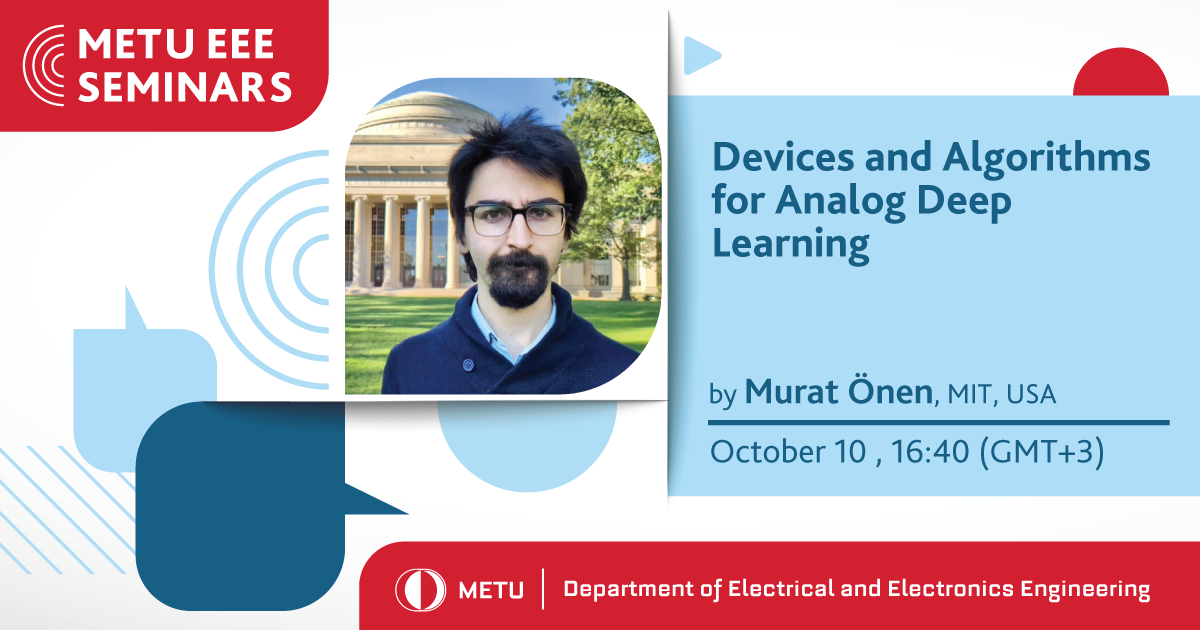
Devices and Algorithms for Analog Deep Learning by Murat Onen
Date: October 10 , 16:40 (GMT+3)
Bio: Murat Onen is a Postdoctoral Researcher at Massachusetts Institute of Technology (MIT). He holds a PhD degree in Electrical Engineering and Computer Science from MIT. He received the B.S. degree in electrical and electronics engineering from METU, in 2017. His research focuses on devices, architectures, and algorithms for analog deep learning which has led to 16 patents and numerous publications to date. Currently, he focuses on developing nanoprotonic programmable resistors and specialized training algorithms for analog crossbar accelerators.
Abstract: Analog deep-learning processors can provide orders of magnitude higher processing speed and energy-efficiency compared to traditional digital counterparts. This is imperative for the promise of artificial intelligence to be realized. However, the implementation of analog processors faces a significant barrier comprising two coupled components: 1) the absence of devices that satisfy stringent algorithm-imposed demands and 2) algorithms that can tolerate inevitable device nonidealities. This talk will present major advancements along both directions: a novel near-ideal device technology and a superior neural network training algorithm. The devices first realized here are CMOS-compatible nanoscale protonic programmable resistors that incorporate the benefits of nanoionics with extreme acceleration of ion transport under strong electric fields. Enabled by a material-level breakthrough of utilizing phosphosilicate glass (PSG) as a proton electrolyte, these devices achieve controlled proton intercalation in nanoseconds with high energy-efficiency. Separately, a theoretical analysis explains the infamous incompatibility between asymmetric device modulation and conventional neural network training algorithms. By establishing a powerful analogy with classical mechanics, a novel method, Stochastic Hamiltonian Descent, has been developed to exploit device asymmetry as a useful feature instead. In combination, the two developments presented in this talk can be effective in ultimately realizing the potential of analog deep learning.